
Norfolk Divorce Decree Records
Norfolk divorce decree records are held by the Norfolk Circuit Court Clerk. Norfolk is one of Virginia's largest independent cities, with about 240,000 residents and a major presence in the Hampton Roads region. As an independent city, Norfolk has its own Circuit Court that handles all divorce filings for city residents. This court is separate from the courts in Chesapeake, Portsmouth, and Virginia Beach, even though those cities all border Norfolk. If you need to find a divorce case, get a certified copy of a final decree, or file a new case, the Norfolk Circuit Court Clerk is where you go. You can start a search online through the Virginia Courts case system, or visit the clerk in person for full access to case files and copies.
Norfolk Overview
Norfolk Circuit Court Clerk
All divorce cases filed by Norfolk residents go through the Norfolk Circuit Court. The Circuit Court Clerk manages every record in the system, from the initial complaint to the final decree and all documents in between. If you need to access a case file, request certified copies, or check on the status of a pending case, this is the right office. Norfolk is a high-volume court given the city's size, so calling ahead to confirm what you need to bring is a good idea.
Because Norfolk is an independent city, it does not share a court with any county. Chesapeake, Portsmouth, and Virginia Beach are also independent cities that border Norfolk, and each has its own Circuit Court. Court records are not shared between these jurisdictions. If a divorce was filed in Norfolk, it is in the Norfolk system. If it was filed in one of the adjacent cities, you need to contact that city's court directly. Norfolk does not have an adjacent county court to worry about, since independent cities in Virginia are geographically separate from county court systems.
| Office | Norfolk Circuit Court Clerk |
|---|---|
| Address | 100 St. Paul's Boulevard Norfolk, VA 23510 |
| Website | Virginia Courts Circuit Court Directory |
| Hours | Monday through Friday, 8:30 AM to 4:30 PM |
| Adjacent Cities | Chesapeake, Portsmouth, Virginia Beach |
Bring valid photo ID when visiting the clerk. If you are requesting records on behalf of a family member, have documentation of your relationship ready. Call ahead to ask about parking and any current procedures at the courthouse entrance.
How to Search Norfolk Divorce Records
Start your search online at the Virginia Courts Case Information system, available through vacourts.gov. This statewide tool covers Circuit Court filings across Virginia, including Norfolk. Search by party name to find basic case information like the filing date, case number, and status. It is free to use and available at any time. The system does not always include older records, so if you don't find a case from decades ago, it may still exist in the courthouse's physical files.
For full records access, visit the clerk in person. You can review the file, see all documents in the case, and request copies. In-person visits are the fastest way to get what you need. Written mail requests are also accepted but take longer to process. If you are on a deadline, going in person is better.
When you search, have at least one of these ready:
- Full name of one or both parties
- Year the case was approximately filed
- Case number if known
Virginia restricts access to divorce records under Virginia Code § 32.1-271. For 25 years after the divorce, records are not open to the public. Only the parties and their immediate family with valid ID can request copies in that period. After 25 years, access is broader. Always bring your ID, and be ready to explain your connection to the case if you are not one of the parties.
Virginia also has residency rules for filing that affect which court a case lands in. The section of the Virginia Code on residency requirements is captured in the screenshot below from the official state legislature website:
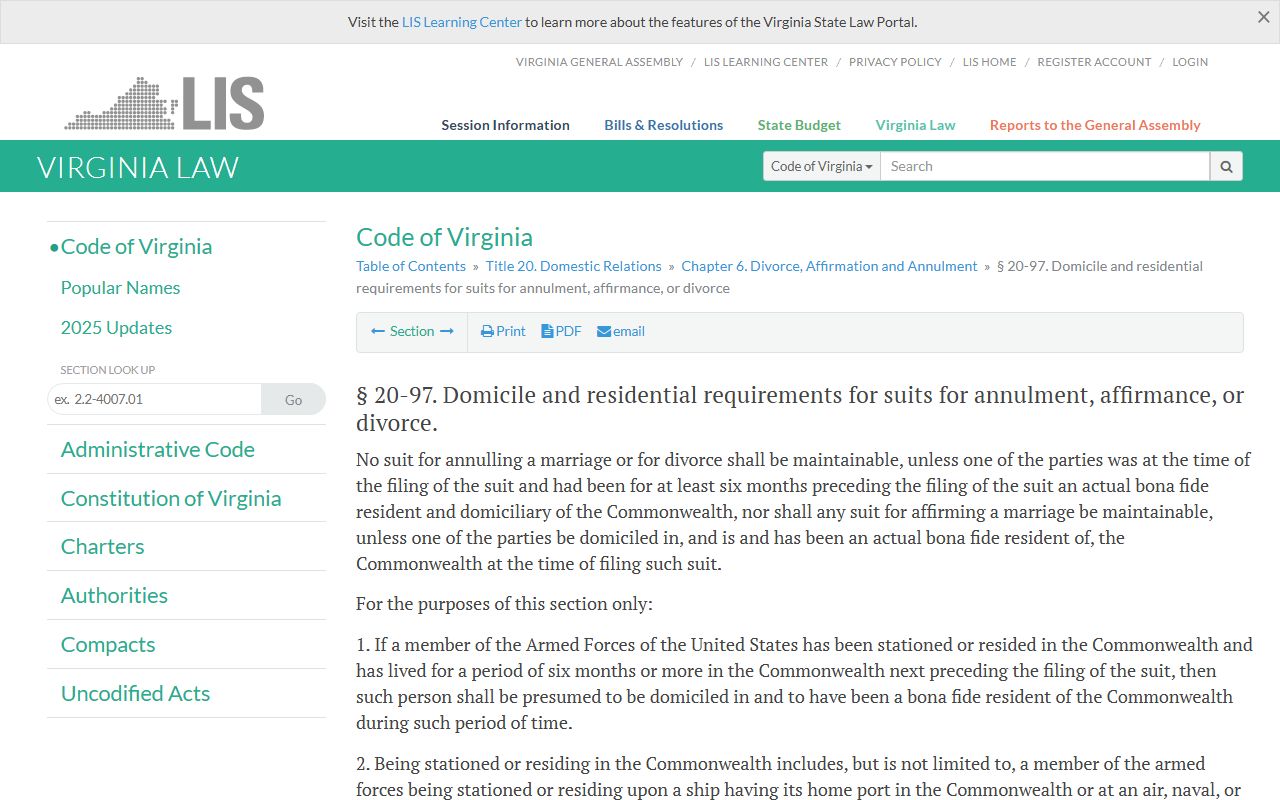
The full text of Virginia Code § 20-97 at the official legislature site explains the six-month residency rule that applies to all Virginia divorce filings, including those in Norfolk.
For a shorter record, the Virginia Department of Health issues divorce certificates at $12 each. VDH is at 8701 Park Central Drive, Suite 100, Richmond VA 23227. Phone: (804) 662-6200. Hours are Monday through Friday, 8:00 AM to 4:30 PM. The VDH website is vdh.virginia.gov/vital-records. VDH certificates confirm the divorce happened but don't include terms like property or custody.
Norfolk Divorce Decree Fees
Court fees for divorce records in Virginia are set by state law under Virginia Code § 17.1-275. The first certified copy of a divorce decree is free. Each additional certified copy costs $0.50 per page plus a $2 certification fee. Plain copies without certification cost less. If you need several certified copies for different agencies, get them all at once to avoid making multiple trips.
VDH divorce certificates are $12 per copy, ordered separately from the court. They are useful for proving the fact of a divorce but not for showing the specific terms. Use the full court decree when the terms matter, such as for property transfers, pension orders, or insurance changes.
The base fee to file a new divorce case in Norfolk is $60 under § 17.1-275. Additional costs can include service of process fees, motions, and any commissioner fees if a deposition is needed. Ask the clerk for a full breakdown. Fee waivers are available for people who cannot afford court costs. Ask the clerk about the process, or contact Virginia Legal Aid at valegalaid.org for help applying.
Fees can change. Always verify the current amounts with the Norfolk Circuit Court Clerk before your visit. Bring exact change or ask in advance about accepted payment methods.
Filing for Divorce in Norfolk
Norfolk residents file for divorce at the Norfolk Circuit Court. Virginia law under Virginia Code § 20-97 requires that at least one spouse have lived in Virginia for six months before filing. Because Norfolk is an independent city, city residency satisfies the state requirement. You do not need to live in a county to file in a Virginia Circuit Court.
Virginia allows both no-fault and fault-based divorce. For a no-fault divorce, the required separation period depends on the circumstances. If there are no minor children and both parties have a written separation agreement, the separation must be at least six months. If there are minor children or no agreement, the required separation is one year. Fault grounds under Virginia Code § 20-91 include adultery, cruelty, desertion, and felony conviction.
Steps to file a divorce in Norfolk:
- File your Complaint for Divorce at the Norfolk Circuit Court Clerk
- Pay the $60 filing fee or request a waiver
- Serve the other party or get a signed waiver of service
- File a separation agreement if applicable
- Attend the final hearing or submit evidence through a commissioner's deposition
- Receive the Final Decree of Divorce once signed by the judge
Norfolk is a large city with a busy court. Uncontested cases where both parties agree tend to move faster than contested ones. If property division, spousal support, or child custody are disputed, the case may require mediation or go to trial. The court can refer parties to mediators to help resolve issues before a final hearing.
You can file without a lawyer in Norfolk, but it is harder in complex cases. The clerk can point you to the right forms and tell you the correct procedure, but they cannot give legal advice. If you need help understanding your rights or filling out the forms, see the resources in the Legal Help section below.
Virginia has a specific process for cases involving military personnel, which is relevant in Norfolk given the large military presence in the Hampton Roads area. Active duty service members have certain protections under federal law that can affect how a divorce proceeds. If one party is on active duty, check with a family law attorney about what extra steps may apply.
Once the final decree is signed, the clerk enters it into the record and provides a certified copy. The first copy is free. You may want to get additional certified copies at the same time for different uses, such as updating a name at the DMV, Social Security Administration, or a financial institution.
What Is in a Norfolk Divorce Decree
The Final Decree of Divorce is a binding court order signed by a Norfolk Circuit Court judge. It legally ends the marriage and sets out the terms that both parties must follow. Courts take violations of the decree seriously, and either party can go back to court to enforce it.
A typical Virginia divorce decree contains:
- Full legal names of both spouses
- Date the court granted the divorce
- Grounds for the divorce as found by the judge
- Property and debt division terms
- Spousal support or alimony provisions, if any
- Child custody and visitation schedule if children are involved
- Child support amount and payment schedule
- Name restoration for either party who requested it
A separation agreement, if one was filed, is typically incorporated into the decree. The decree itself may reference the agreement rather than restating all the terms in full. In that case, you need both documents to understand everything that applies. The clerk can tell you what documents are in the case file.
A VDH divorce certificate is a different, shorter document. It confirms that the divorce happened and provides the names and date, but it does not include property, support, or custody terms. Use the court-certified decree when you need to prove specific terms. Use the VDH certificate when you only need to confirm the fact of the divorce.
Legal Help in Norfolk
Norfolk has solid access to legal resources for people dealing with divorce. Whether you need help with a record request, a new filing, or understanding the terms of an existing decree, there are places to turn. The city's size means more options are available here than in smaller Virginia cities.
Virginia Legal Aid at valegalaid.org provides free civil legal services to lower-income residents. They serve the Hampton Roads area and handle family law cases including divorce. If you qualify based on income, they can help you with the filing process, forms, and knowing your rights. Call or visit their website to apply and find the nearest office.
The Virginia State Bar at vsb.org runs a lawyer referral service. You can search for family law attorneys serving Norfolk and the Hampton Roads area. Many attorneys in this region handle cases in multiple Hampton Roads cities, so finding someone with Norfolk court experience is straightforward. A referral can connect you with an attorney who knows the local judges and procedures well.
For self-help resources, the Virginia Courts website at vacourts.gov has official forms and guides for Circuit Court divorce filings. All forms are approved for use in Virginia courts and can be downloaded for free. The clerk's office can tell you which forms apply to your situation and what order to file them in.
Norfolk also has resources for military families. Given the large Navy and military presence in the city, some legal aid organizations and law firms have experience with military divorce issues, including the Servicemembers Civil Relief Act, military pension division, and related matters. If one party is on active duty, ask specifically about military family law when you contact an attorney or legal aid.
If safety is a concern, contact Virginia Legal Aid or local domestic violence resources before filing. The court can take steps to protect your address and personal information during the case if needed. Norfolk also has local shelters and advocacy groups that can help connect you with safe legal resources and temporary housing if necessary.
Adjacent City Divorce Records
Norfolk is an independent city bordered by other independent cities, not counties. Cases filed in those neighboring cities are in their own Circuit Courts. Use the links below if the divorce you are looking for was filed in a bordering city.
Nearby Cities
These Virginia cities are near Norfolk in the Hampton Roads area. Each is an independent city with its own Circuit Court handling divorce cases.