
Radford Divorce Decree Records
Divorce decree records in Radford are held by the Radford Circuit Court Clerk. Radford is an independent city in the New River Valley, home to Radford University, and it operates its own Circuit Court separate from the surrounding Montgomery County. If you need to find a divorce case filed in Radford or get a certified copy of a divorce decree, the Radford Circuit Court Clerk is where you start. You can search by name or case number in person, and the clerk can pull records from past cases and make certified copies on request. Access to divorce records in Virginia is limited under state law, so you will need to show valid ID and confirm your eligibility before the clerk can release documents.
Radford Overview
Radford Circuit Court Clerk
Radford is an independent city, which means it has its own Circuit Court that is not part of Montgomery County. The Radford Circuit Court Clerk handles all divorce filings, maintains case records, and processes requests for certified copies of divorce decrees. This is the office you contact for any records matter related to a Radford divorce case.
The clerk's office keeps records going back many years. Older records may be on microfilm or stored off-site. If you are looking for a case from more than ten or fifteen years ago, give the clerk a call first to check on availability before you make the trip. They can usually tell you over the phone whether the file is on hand.
| Office | Radford Circuit Court Clerk |
|---|---|
| Address | 619 Second Street Radford, VA 24141 |
| Phone | (540) 731-3610 |
| Hours | Monday through Friday, 8:30 AM to 4:30 PM |
| Website | vacourts.gov |
When you visit the clerk's office, bring a valid government-issued photo ID. Virginia limits access to divorce records, so you need to show who you are. The clerk will ask why you need the record if you are not a party to the case. Immediate family members with valid ID can typically access these records as well.
How to Search Radford Divorce Records
You can search Radford divorce records in person at the Radford Circuit Court or online through the Virginia Courts Case Information system. The online system shows basic case information like party names, case status, and filing dates. It does not show the full text of documents. For that, you need to visit the clerk or request copies by mail.
The Virginia Courts online portal is available at vacourts.gov. From there you can find links to the Circuit Court case search system. You can search by last name and a general time range. The results will show you the case number, parties, and status. That is usually enough to confirm whether a case exists and whether it was finalized.
To search, you will need at least one of the following:
- Full name of one spouse (last name is enough to start)
- Case number if you already have it
- Approximate year the case was filed or finalized
In person at the clerk's office, staff can search by name or case number and tell you what is in the file. They can also make copies. Plain copies cost $0.50 per page. Certified copies cost $2.00 for the certification plus $0.50 per page. The first certified copy of a final decree is free under Virginia Code § 17.1-275.
Virginia divorce records are restricted under Virginia Code § 32.1-271. Records less than 25 years old are not open to the general public. Only the parties to the case and their immediate family members with valid ID can get copies of recent divorce decrees. Older records may be more accessible, but it depends on the specific case and what the court sealed.
The Virginia Department of Health also holds divorce certificates for cases finalized after 1918. These are shorter summary documents, not full decrees. You can request a divorce certificate from the VDH Office of Vital Records at 8701 Park Central Drive, Suite 100, Richmond, VA 23227. The fee is $12 per copy. Call (804) 662-6200 or visit vdh.virginia.gov/vital-records for more details.
Radford Divorce Record Fees
Fees for divorce records in Radford follow the statewide schedule set by the Virginia General Assembly under Virginia Code § 17.1-275. The clerk's office does not set its own rates. All Virginia circuit courts charge the same amounts for certified copies.
Current fee schedule:
- Filing fee for divorce: $60
- First certified copy of final decree: FREE
- Additional certified copies: $2.00 certification fee plus $0.50 per page
- Plain (uncertified) copies: $0.50 per page
- VDH divorce certificate: $12 per copy
The free first certified copy applies at the time the divorce is finalized. If you come back later and need a certified copy of a decree from an old case, the $2.00 plus per-page fee applies. Most final decrees run two to five pages, so costs are usually modest. Call the clerk ahead of time if you want an estimate for your specific case.
If you need a divorce certificate rather than the full decree, go through VDH rather than the court. The VDH certificate is a one-page summary that lists the parties, date, and county. It works for most official purposes like name changes, remarriage, and insurance updates. The full decree is needed if you want to verify property terms, custody orders, or support agreements.
Filing for Divorce in Radford
To file for divorce in Radford, you or your spouse must have lived in Virginia for at least six months before filing. This residency requirement is set by Virginia Code § 20-97. Since Radford is an independent city, you file at the Radford Circuit Court rather than any county court. That is true even if your spouse lives in Montgomery County next door.
Virginia law sets out the grounds for divorce under Virginia Code § 20-91. No-fault divorce requires either a one-year separation or a six-month separation if the couple has a written separation agreement and no minor children. Fault grounds include adultery, cruelty, desertion, and felony conviction with imprisonment. The grounds you choose affect which records get filed and how long the case takes.
Uncontested divorces in Radford can move relatively fast. If both spouses agree on all terms and meet the separation period, the court can grant the divorce without a hearing in some cases. You still need to file the proper paperwork and have the clerk enter the final decree. Contested cases take longer and may require hearings before a judge.
Virginia does not have a waiting period after filing the way some states do. The required separation period happens before you file. Once all paperwork is in order and the grounds are met, the court can move forward without additional delay.
The clerk's office can tell you which forms you need to start a case. Forms are also available through the Virginia Courts website. If your case involves children, property division, or support, it is worth talking to a lawyer before you file. The clerk's staff cannot give legal advice, but they can show you where to find the official forms and tell you what must be included in the filing packet.
What Virginia Divorce Decrees Contain
A final divorce decree from the Radford Circuit Court is a court order signed by a judge. It is the legal document that ends the marriage. The decree sets out all the terms the court has approved, whether the spouses agreed to them or the judge decided after a hearing.
Typical contents of a Virginia divorce decree include:
- Names of both spouses and the date of marriage
- Grounds for divorce as found by the court
- Date the divorce is granted
- Property and debt division terms
- Spousal support (if awarded)
- Child custody and visitation schedule (if applicable)
- Child support amount and payment terms (if applicable)
- Any name restoration if requested
The decree is a public record in the sense that it is filed with the court, but access is restricted under Virginia law for recent cases. Once 25 years have passed, access generally opens up more broadly. For a case finalized in the last 25 years, only the parties and their immediate family can get a copy. This rule comes from Virginia Code § 32.1-271.
Some courts also file separate exhibits, financial disclosure forms, separation agreements, and other supporting documents as part of the case file. These are generally accessible to the parties. Third parties cannot get those documents without a court order in most situations.
The Virginia Department of Health also maintains a separate screenshot of the Virginia Code governing divorce access. The grounds for divorce that affect what the record contains are explained at the official statute page:
The Virginia General Assembly's website explains the specific code section covering grounds for divorce. You can see that page at the link below.
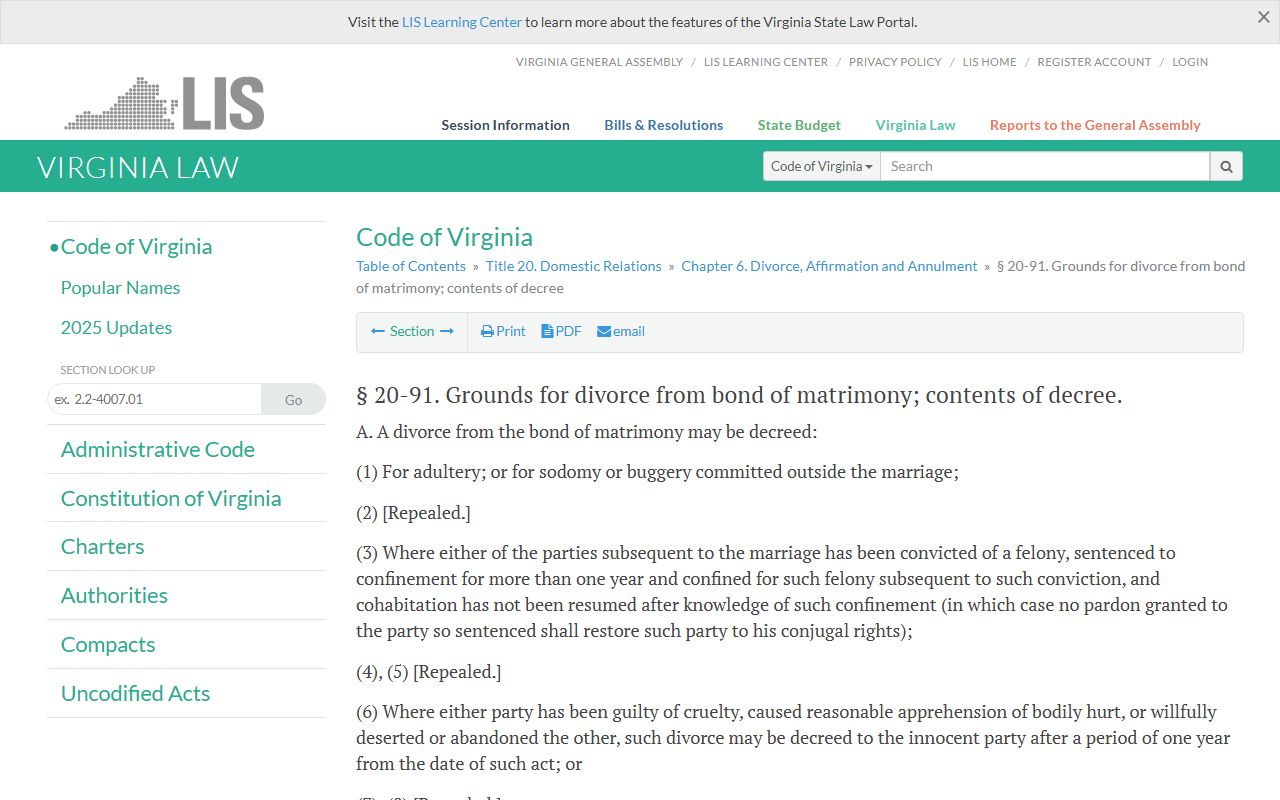
This page, hosted at law.lis.virginia.gov, covers the fault and no-fault grounds that courts use when entering a final decree.
Legal Help for Radford Divorce Cases
Getting help with a divorce case in Radford is possible even if money is tight. Several organizations serve the New River Valley area and can assist with family law matters at low or no cost. The court itself cannot give legal advice, but these groups can.
Virginia Legal Aid offers services to low-income residents across the state. Their statewide intake line can connect you to a local office that covers the Radford area. Visit valegalaid.org to find out if you qualify and to start an application. They handle family law matters including divorce, custody, and support cases.
The Virginia State Bar operates a lawyer referral service that can connect you with a private attorney for an initial consultation. Visit vsb.org for more information. Referral consultations are often available at reduced rates, which gives you a chance to talk to a licensed attorney before deciding how to proceed.
If you want to handle the divorce on your own, the Virginia Courts website has forms and guides at vacourts.gov. The clerk can tell you which forms apply to your situation, though they cannot tell you how to fill them out. For simple uncontested cases with no children and no major property, self-represented filing is more straightforward. Cases involving kids, real estate, retirement accounts, or disputes are harder to handle without a lawyer.
Nearby Cities
These independent cities are near Radford. Each has its own Circuit Court that handles divorce filings for residents of that city.
Adjacent County
Montgomery County surrounds Radford. County residents file their divorce cases through the Montgomery County Circuit Court, not the Radford court.