
Search Richmond Divorce Decree Records
Divorce decree records in Richmond are filed at the Richmond Circuit Court Clerk's office. Richmond is Virginia's state capital and its largest independent city, with a population of about 227,000. As an independent city, Richmond operates its own Circuit Court that is completely separate from Henrico and Chesterfield Counties. Richmond also has a distinct advantage for residents seeking vital records: the Virginia Department of Health Office of Vital Records is located right in the city at 8701 Park Central Drive, Suite 100. That means Richmond residents can visit both the court and the state vital records office without leaving the city. This page covers where to find divorce decrees, how access works, what the records contain, and where to get help.
Richmond Overview
Richmond Circuit Court Clerk
The Richmond Circuit Court Clerk handles all divorce filings for the City of Richmond. Because Richmond is an independent city, it has its own Circuit Court and its own clerk's office. This is not the same court that serves Henrico County or Chesterfield County. If a divorce was filed by a Richmond city resident, the case records are at the Richmond Circuit Court, not at any county courthouse.
The clerk's office holds case files, issues certified copies of decrees, and maintains the docket for all civil cases including divorce. For older cases, records may be stored off-site or on microfilm. Calling ahead before a visit is a good idea, especially if you are looking for a case that is more than ten years old. The clerk can often confirm availability and estimated copy time over the phone.
| Office | Richmond Circuit Court Clerk |
|---|---|
| Address | John Marshall Courts Building 400 North 9th Street Richmond, VA 23219 |
| Phone | (804) 646-6505 |
| Hours | Monday through Friday, 8:00 AM to 4:00 PM |
| Website | vacourts.gov |
The John Marshall Courts Building is in downtown Richmond near City Hall. Street parking and nearby garages are available. You must go through security at the entrance, so bring a photo ID and leave anything you don't need in the car. The clerk's staff can answer basic questions about the records process, but they cannot give legal advice.
How to Search Richmond Divorce Records
You can search Richmond divorce records online through the Virginia Courts case information system or in person at the Richmond Circuit Court. The online system shows party names, case numbers, filing dates, and status. It does not show the contents of documents. To read the actual decree or other filed papers, you need to visit the clerk or request copies.
Start your online search at vacourts.gov. The site links to the Circuit Court case search portal, where you can enter a last name and narrow results by year. Richmond is a large city with many cases filed each year, so having a full name and an approximate date makes the search faster. The case number, once you find it, speeds up everything else.
To search, you typically need:
- Last name of one spouse (first name helps narrow results)
- Year the case was filed or the year the divorce was finalized
- Case number if you have it from prior paperwork
In person, the clerk's staff can search by name and pull case files. They can make plain copies at $0.50 per page or certified copies for $2.00 plus $0.50 per page. The first certified copy of a final decree is free under Virginia Code § 17.1-275, but that applies at the time the case closes. If you come back later for a copy of an old case, the regular fee applies.
Virginia limits access to recent divorce records. Under Virginia Code § 32.1-271, records less than 25 years old are restricted to the parties and their immediate family with valid ID. A third party cannot walk in and get a copy of someone else's recent divorce decree without a court order. For cases older than 25 years, access is generally broader.
Richmond residents also benefit from the VDH Office of Vital Records being located here. For a shorter summary document called a divorce certificate, you can visit VDH directly at 8701 Park Central Drive, Suite 100, Richmond, VA 23227. The fee is $12 per copy. The VDH certificate is useful for name changes, remarriage applications, and other official purposes where a full decree is not required. Call (804) 662-6200 or visit vdh.virginia.gov/vital-records for more details.
The VDH website for vital records is shown below. Richmond residents can visit this office in person, which is a convenience not available in most other Virginia cities.
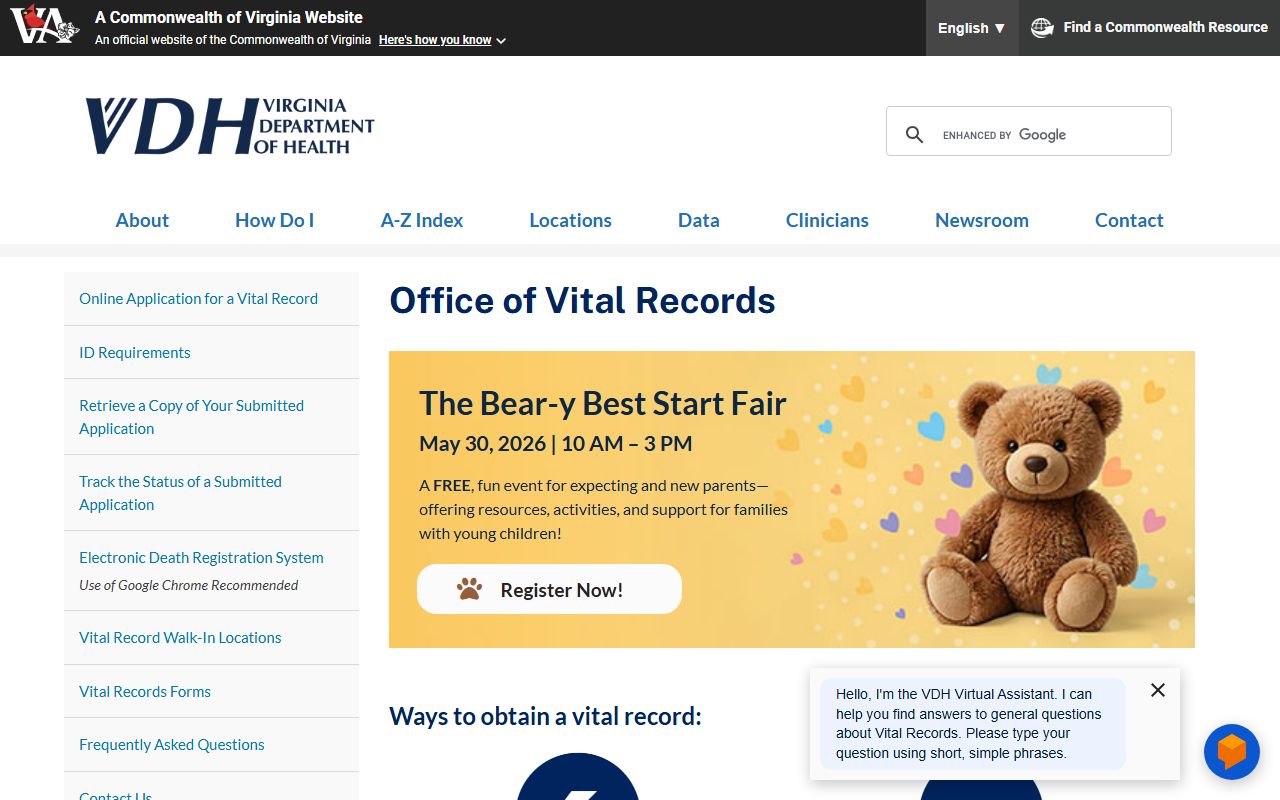
The VDH vital records page at vdh.virginia.gov/vital-records covers how to request divorce certificates and other vital records by mail, in person, or online.
Richmond Divorce Record Fees
The fees for divorce records in Richmond are set by state law. The Richmond Circuit Court Clerk follows the same fee schedule as all other Virginia circuit courts under Virginia Code § 17.1-275. The clerk does not set local rates, so what you pay in Richmond is the same as what you pay in any other Virginia circuit court.
Current fees:
- Filing fee for divorce: $60
- First certified copy of final decree at case close: FREE
- Additional certified copies: $2.00 certification plus $0.50 per page
- Plain (uncertified) copies: $0.50 per page
- VDH divorce certificate: $12 per copy
Most final divorce decrees run between two and six pages. A certified copy of a standard decree will cost around $3.00 to $5.00 at the normal rate. Call the clerk if you want an estimate for your specific case, since longer decrees with multiple exhibits cost more. Payment methods accepted by the clerk's office typically include cash, check, and credit or debit card, but it is worth confirming before you visit.
If you cannot afford the filing fee when starting a divorce case, you can ask the court to waive it. You will need to fill out a form showing your income and expenses. People who receive public assistance or earn below a certain income threshold often qualify. Ask the clerk's office for the fee waiver form or look for it on the Virginia Courts website.
Filing for Divorce in Richmond
To file for divorce in the Richmond Circuit Court, at least one spouse must have lived in Virginia for six months before filing. This is the residency requirement under Virginia Code § 20-97. Because Richmond is an independent city, you file here if you live in the city. You do not file in Henrico or Chesterfield even if your spouse lives in one of those counties. Each party files in the court for the city or county where they live, or where the couple last lived together.
Virginia allows divorce on both fault and no-fault grounds under Virginia Code § 20-91. The no-fault path requires a separation of at least one year, or six months if both spouses have a written separation agreement and there are no minor children. Fault grounds include adultery, cruelty, desertion, and conviction of a felony with imprisonment. The grounds you choose affect how quickly the case moves and what records are generated.
Uncontested divorces can move faster. If both spouses agree on everything, they can submit an agreed final decree and request the court to enter it without a hearing. The judge still reviews the agreement and signs the decree, but there may be no court date required. Contested cases with disputed property, custody, or support issues often require hearings and can take much longer.
Virginia does not require a waiting period after filing the way some states do. The separation happens before you file, not after. Once you meet the required separation period and file all necessary documents, the court can finalize the divorce without additional delay.
All forms needed to start a divorce case in Richmond are available through the Virginia Courts website. The clerk can point you to the right forms, but staff cannot fill them out for you or tell you which grounds to use. For anything beyond basic form questions, consult a licensed attorney.
What Richmond Divorce Decrees Contain
A final divorce decree from the Richmond Circuit Court is a signed court order. It is the document that legally ends the marriage. The decree reflects the terms the court approved, whether by agreement of the spouses or after a judge's ruling on disputed issues.
Richmond divorce decrees typically include:
- Names of both spouses and the date of the marriage
- Grounds for divorce as found or accepted by the court
- Date the divorce is granted and effective
- Division of marital property and debts
- Spousal support terms if any were ordered
- Child custody, visitation, and parenting schedule if applicable
- Child support amount and payment schedule if applicable
- Name restoration if one spouse requested it
The case file may also contain separate exhibits, financial affidavits, separation agreements, and other documents filed by the parties. All of these are part of the official record held by the clerk. Access to the full file is subject to the same restrictions as the decree itself. Recent cases are not open to the public under Virginia Code § 32.1-271.
For cases where a divorce certificate from VDH is enough, note that the VDH certificate is a shorter document. It confirms the divorce happened and gives basic facts but does not include property, custody, or support terms. Use the VDH certificate for administrative purposes and the full court decree when you need to show specific terms.
Legal Help for Richmond Divorce Cases
Richmond has a range of legal resources for people who need help with divorce cases. Some are free for those who qualify. Others offer reduced-rate consultations. The city's size means more options are available here than in smaller Virginia communities.
Virginia Legal Aid provides free civil legal services to low-income residents. They handle family law matters including divorce, custody, and protective orders. Visit valegalaid.org to check eligibility and apply. The Richmond area office serves city residents and can be reached through the statewide intake process on that website.
The Central Virginia Legal Aid Society also serves Richmond and surrounding areas. They focus on civil cases for people who cannot afford private attorneys. Contact them for information about family law assistance in the city.
For private attorney referrals, the Virginia State Bar runs a lawyer referral service. Visit vsb.org to find a licensed attorney who handles family law in Richmond. Initial consultations through the referral program are often available at a set low rate. This gives you a chance to talk through your case before committing to full representation.
The Richmond Circuit Court has a self-help section in the clerk's office. Staff there can give you forms and explain filing procedures. They cannot give legal advice, but they can help you understand what documents go into a basic divorce filing. Official court forms are at vacourts.gov.
Nearby Cities
These independent cities are near Richmond. Each one has its own Circuit Court that handles divorce filings for city residents.
Adjacent Counties
Henrico and Chesterfield Counties border Richmond. Residents of those counties file at their county circuit courts, not at the Richmond city court.