
Search Prince William County Divorce Decree Records
Prince William County divorce decree records are filed and maintained at the Circuit Court Clerk's office in Manassas, Virginia. With a population of about 480,000, Prince William is one of Virginia's largest and fastest-growing counties, and its Circuit Court handles a high volume of family law cases each year. If you need to look up a divorce case, get a certified copy of a final decree, or find out the status of a pending filing, the clerk's office in Manassas is where you go. The county is located in Northern Virginia, southwest of Washington, D.C., and includes the independent cities of Manassas and Manassas Park within its broader area.
Prince William County Overview
Prince William County Circuit Court Clerk
The Circuit Court Clerk in Manassas is the official keeper of all divorce records for Prince William County. The clerk's office manages new filings, stores case files, and issues certified copies of final decrees. All divorce cases filed by county residents go through this office. Staff can search records by name or case number and help you get copies of documents you need.
Prince William County is part of Virginia's 31st Judicial Circuit. The courthouse sits in the city of Manassas, which serves as the county seat. Because the county is so large, the clerk's office handles a significant volume of family law filings each year. If you are coming in person, it is worth calling ahead to confirm what documents or forms of payment you need to bring.
The Virginia Department of Health also keeps divorce certificates for cases where a final order was issued. The VDH office is at 8701 Park Central Drive, Suite 100, Richmond, VA 23227. You can reach them at (804) 662-6200. Their office is open Monday through Friday, 8:00 AM to 4:30 PM. For a full court file, however, you need the Circuit Court Clerk in Manassas, not VDH.
| Office | Prince William County Circuit Court Clerk |
|---|---|
| Address |
Prince William County Courthouse 9311 Lee Avenue Manassas, VA 20110 |
| Phone | (703) 792-6015 |
| Hours | Monday through Friday, 8:00 AM to 4:00 PM |
| Circuit Court Directory | vacourts.gov |
How to Search Prince William County Divorce Records
You can search Prince William County divorce records online, in person, or by mail. The fastest option for basic case info is the statewide online search tool. For certified copies of actual documents, you need to contact the clerk's office directly. In-person visits let you see the full file and walk out with copies the same day.
Virginia's court system makes case information available through an online portal at no charge. You can search by party name or case number. The results show the names of the parties, the filing date, case type, and current status. The system does not show the full text of court documents, so if you need the decree itself, you have to request it from the clerk.
To search, you will need:
- At least one spouse's full name
- The approximate year the case was filed
- Case number if you have it
To get a certified copy, contact the clerk's office and let them know what you need. You can do this by phone, in person, or by mailing a written request. Include the full names of both parties, the year of the divorce, a daytime phone number or email, and payment. The clerk will confirm whether the record is on file and the total cost before processing your request.
Under § 32.1-271 of the Virginia Code, divorce certificates held by VDH are restricted for 25 years from the date the record was filed. During that window, only the parties to the divorce and immediate family members with valid ID can request a copy from VDH. Court records at the clerk's office operate under different rules and are generally public.
The Virginia Department of Health vital records office at vdh.virginia.gov/vital-records handles divorce certificates. These are not the same as a full divorce decree. If you need the actual court order, contact the Circuit Court Clerk.
Prince William County Divorce Record Fees
Fees for divorce records in Prince William County are set by Virginia state law under § 17.1-275. The filing fee to open a new divorce case is $60, paid to the clerk at the time of filing. That fee does not include service costs, additional court fees, or attorney fees.
Fees for copies of divorce records:
- First certified copy of a final decree: free under § 17.1-275
- Additional certified copies: $0.50 per page plus a $2.00 certification fee
- Plain (uncertified) copies: $0.50 per page
- VDH divorce certificates: $12 each, ordered through VDH
There may be additional charges for searches that require staff to look through older records manually. If you need copies of many documents from a case file, costs can add up. Call ahead to get an estimate. The clerk's office will tell you the full amount before you pay.
Fee waivers: People who cannot afford court costs may request a waiver. Ask the clerk's office about the process. You will likely need to show proof of income or financial hardship.
Filing for Divorce in Prince William County
To file for divorce in Prince William County, you must first meet Virginia's residency rule. Under § 20-97 of the Virginia Code, at least one spouse must have lived in Virginia for at least six months before filing. If that requirement is met, you can file in the county where either spouse currently resides.
Virginia law allows both no-fault and fault-based grounds for divorce. No-fault divorce requires the parties to live separately for at least six months if they have no minor children and have a written settlement agreement. If minor children are involved, the required separation period is one year. Fault grounds under Virginia law include adultery, cruelty, willful desertion, and felony conviction followed by imprisonment.
To start a divorce case, one spouse files a Complaint for Divorce with the Circuit Court Clerk and pays the $60 filing fee. The other spouse must be properly served with the complaint. If both parties agree on all terms, they can submit a settlement agreement and ask the court to approve it without a full trial. If they disagree on things like property, custody, or support, the case may go to a hearing or trial before a judge enters the final decree.
Virginia divides property under equitable distribution law. That means the court looks at what each spouse brought to the marriage, what was acquired during the marriage, and other factors before deciding how to split things up. Marital property is subject to division; separate property generally is not. Debts are also divided as part of the process.
Prince William County has a large population and active family court docket. Wait times for hearings can vary. If you are in a hurry, an agreed divorce without contested issues will move through the system faster than a contested case that needs a trial date.
What Prince William County Divorce Records Contain
Divorce records in Prince William County consist of all the documents filed during a case. The final divorce decree is the core document. It is the signed court order that ends the marriage and spells out all the terms. That includes property division, support obligations, and any custody or visitation arrangements for children.
Other documents that may be part of the case file include:
- Complaint for Divorce
- Proof of service on the other party
- Financial affidavits
- Property settlement agreement
- Child support worksheet
- Custody and visitation order
- Spousal support order if applicable
- Hearing transcripts in contested cases
The final decree itself includes the full legal names of both parties, the date the divorce was granted, and all the court's rulings. Many people need a certified copy for purposes like changing a name with the DMV or Social Security Administration, updating insurance policies, or proving marital status for a future marriage.
Most divorce records at the clerk's office are public. You do not need to be a party to the case to view the file or request copies. Some financial documents may be sealed by court order. Records involving minor children may also have limited access in certain situations.
Legal Help in Prince William County
Several resources can help you with a divorce in Prince William County. If you qualify based on income, legal aid may be able to assist at no cost. The state bar has a referral service for those looking for a private attorney. Self-help options also exist if you plan to handle the case yourself.
Virginia Legal Aid serves low-income residents across Virginia, including family law matters like divorce, custody, and support. Their site can help you find the right local office. In Northern Virginia, several legal aid organizations are active and can offer guidance for people going through divorce without an attorney.
The Virginia State Bar lawyer referral service can help you find a licensed attorney in Prince William County. Many family law attorneys in the area offer a first consultation at a reduced rate. The Circuit Court Clerk's office can also point you to self-help forms for common family law filings, though staff cannot provide legal advice on your specific situation.
The Virginia Department of Health maintains a vital records office that serves Prince William County residents. Information about VDH services is available at the agency's regional page:
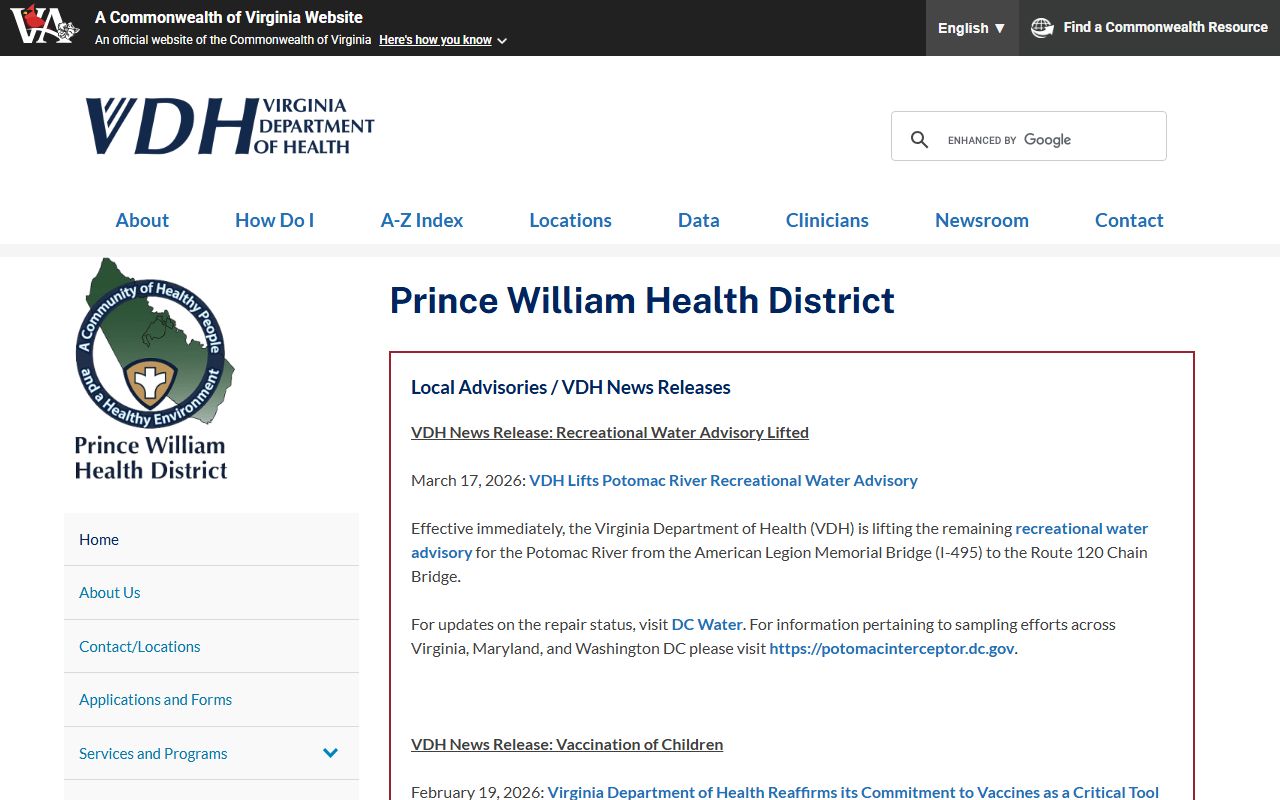
VDH divorce certificates ($12 each) are short-form documents showing basic divorce facts. For the full court record, contact the Prince William County Circuit Court Clerk in Manassas. More information is available at vdh.virginia.gov/prince-william.
Cities Near Prince William County
The independent cities of Manassas and Manassas Park are surrounded by Prince William County but have their own separate court systems. People who live within the county boundaries file at the Prince William Circuit Court in Manassas.
Other communities in and near Prince William County include Woodbridge, Dale City, Lake Ridge, Dumfries, Gainesville, and Haymarket. Residents of those unincorporated areas file at the Prince William County Circuit Court.
Nearby Counties
These counties are adjacent to Prince William County. If you are not sure which county handles your case, check which county your current address falls in. You must file where you or your spouse lives.