
Search Lynchburg Divorce Decree Records
Divorce decree records in Lynchburg are held by the Lynchburg Circuit Court, which serves this independent city in central Virginia. As an independent city, Lynchburg has its own Circuit Court Clerk who maintains all divorce case files and processes records requests separate from any surrounding county. If you need a certified copy of a final decree, want to verify a past divorce, or are searching for case records, the Lynchburg Circuit Court Clerk is the correct office to contact. State law governs how these records are accessed and who qualifies to receive them.
Lynchburg Overview
Lynchburg Circuit Court Clerk
Lynchburg is one of Virginia's independent cities, which means it operates its own circuit court that functions separately from Campbell County, Amherst County, and Bedford County, all of which border the city. Residents who live within Lynchburg city limits file for divorce at the Lynchburg Circuit Court, not at any of the surrounding county courts. The Circuit Court Clerk manages all divorce filings, case files, and records for the city.
The clerk is an elected official who is responsible for keeping accurate court records. The office processes new filings, maintains existing case files, and handles records requests from the public and from attorneys. Staff can look up cases by name or case number, make copies of documents, and issue certified copies of final decrees with the court seal.
| Office | Lynchburg Circuit Court Clerk |
|---|---|
| Address | 900 Court St, Lynchburg, VA 24504 |
| Jurisdiction | City of Lynchburg (independent city) |
| Court System | Virginia Circuit Courts |
Lynchburg is one of the larger independent cities in central Virginia, with a court that handles a significant volume of family law cases each year. It is worth calling ahead to ask about the best time to visit and what documents to bring. The Virginia Courts website lists contact information and hours for all Virginia circuit courts.
The clerk's office fee schedule follows state law on circuit court clerk fees. You can review that statute at the link below, which covers the fees that apply to filings, copies, and certifications at Virginia Circuit Courts.
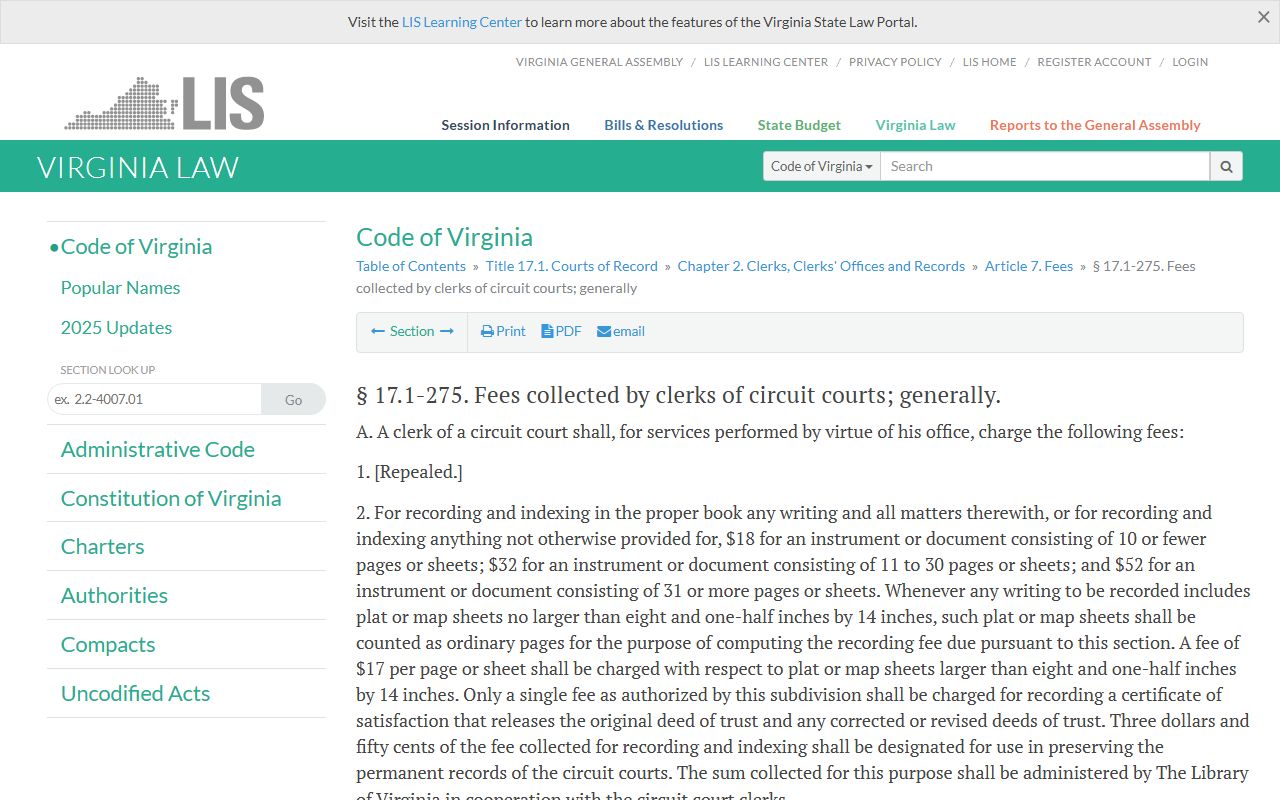
This page on the Virginia legislature's website covers the full fee schedule for circuit court clerks, including the amounts charged for certified copies of divorce decrees.
How to Search Lynchburg Divorce Records
You can look up divorce records in Lynchburg through the state's online case information system or by visiting the Lynchburg Circuit Court Clerk in person. The online system is a good first step. It is free to use and lets you confirm whether a case exists before you make the trip to the courthouse.
The Virginia Judiciary's public case information system at vacourts.gov lets you search by party name or case number. You can see filing dates, party names, and hearing records. The online system does not provide full document access or certified copies.
To get a certified copy of a final decree, you need to visit the Lynchburg Circuit Court Clerk's office in person or send a written request by mail. In-person requests are typically processed on the same visit. Bring valid government-issued photo ID. Tell the clerk the names of the parties and the approximate year the divorce was filed or finalized, and staff will locate the case and make copies.
Under Virginia Code § 32.1-271, divorce records are not open to the general public for 25 years from the date of filing. Only the parties and their immediate family members can access restricted records during that period. Cases older than 25 years are generally open to anyone. If you are a family member requesting access to a newer record, bring ID and documentation showing your relationship to a party.
The Virginia Department of Health also keeps a statewide record of divorces in the form of divorce certificates. These are brief documents that confirm a divorce was finalized. They are different from the court decree and do not include the case details or property terms. You can request a VDH divorce certificate through their vital records office at vdh.virginia.gov/vital-records. The fee is $12 per certificate.
To search or request records, it helps to have:
- Full name of at least one party as it appeared at the time of filing
- The approximate year the case was filed
- Case number if you have it
Divorce Decree Fees in Lynchburg
Fees for divorce records and filings in Lynchburg are set by state law under Virginia Code § 17.1-275. These fees apply at every Virginia Circuit Court, including Lynchburg.
Current fees include:
- Filing fee to start a divorce case: $60
- First certified copy of the final decree: free under § 17.1-275
- Additional certified copies: $0.50 per page plus $2.00 certification fee
- Uncertified (plain) copies: $0.50 per page
- VDH divorce certificate: $12 per certificate
There are no local surcharges on top of the state fee schedule in Lynchburg. However, it is always good to call the clerk's office and confirm current amounts, since fees can change when the legislature amends the statute. Ask about accepted payment methods as well, since not all offices take credit or debit cards for copy requests.
The first certified copy of the final decree is free at the time the divorce is finalized. If you need to come back later and get additional copies, each one will carry the per-page and certification fee. For most purposes, a single certified copy is sufficient, as many agencies will accept a photocopy once they have seen the original.
If you cannot afford court costs, Virginia law allows you to file a request for a fee waiver. Ask the clerk's office about the procedure and forms required to apply.
Filing for Divorce in Lynchburg
To file for divorce in Lynchburg, at least one spouse must have been a Virginia resident for at least six months before filing. This is required under Virginia Code § 20-97. Since Lynchburg is an independent city, you file at the Lynchburg Circuit Court, not at the courts for Campbell, Amherst, or Bedford counties.
Virginia recognizes both no-fault and fault-based divorce. The no-fault route requires that the couple has lived separate and apart for one year. If there are no minor children and both spouses have signed a written separation agreement, that period drops to six months. Fault grounds include adultery, cruelty, willful desertion or abandonment, and conviction of a felony resulting in confinement.
The filing process begins when one spouse submits a Bill of Complaint for Divorce to the Lynchburg Circuit Court Clerk and pays the $60 filing fee. The other spouse must then be served with a copy of the complaint and a summons. Service can be done through a sheriff, a process server, or by the other party accepting service voluntarily. Once service is complete, the case proceeds through the court system.
Uncontested cases, where both parties agree on all terms, can often be resolved through a commissioner in chancery. The commissioner takes evidence, reviews the agreement, and makes a report to the judge recommending that the divorce be granted. The judge then signs the final decree. Contested cases take longer and may require hearings and mediation before the court can resolve all disputes.
Each step in the process creates documents that become part of the permanent case file. That file is maintained by the Lynchburg Circuit Court Clerk and is the record you would access later if you need a copy of the decree or other case documents.
What a Divorce Decree Contains
A final divorce decree from the Lynchburg Circuit Court is a court order signed by the judge that legally ends the marriage. It is the key document you need to prove that a divorce occurred and to show what terms the court set. Decrees include the full names of both parties, the date of the decree, and the legal grounds for the divorce.
Depending on the issues in the case, a decree may also include:
- Division of marital property and debts
- Spousal support or alimony terms and amounts
- Child custody and visitation schedule
- Child support obligations
- Restoration of a former name if one party requested it
Simple cases with no children and limited shared property often produce short decrees. Complex cases with contested property, custody, or support disputes produce longer documents that lay out each term in detail. If a separation agreement was incorporated into the decree, those terms become part of the court order and are enforceable as such.
Certified copies of the decree carry the clerk's official seal and are required for many legal purposes. When you are changing your name at the DMV or Social Security Administration, remarrying, handling estate matters, or presenting the decree to a court in another state, you will generally need a certified copy. Check with the agency or court receiving the document to confirm which format they require.
Legal Help for Divorce in Lynchburg
Several organizations can help Lynchburg residents navigate the divorce process. Some provide free services to those who qualify based on income. Others connect you with licensed attorneys who can advise you or represent you in court. Even if you plan to file on your own, a single consultation can help you avoid errors that take time and money to fix.
Virginia Legal Aid serves the Lynchburg area and handles family law matters for those who meet income requirements. Their services may include help with forms, legal advice, and in some cases direct representation. You can reach them through valegalaid.org. Availability depends on current caseload and eligibility.
The Virginia State Bar runs a lawyer referral service that can match you with a family law attorney in the Lynchburg area. Visit vsb.org for details on how to use the service. Many family law attorneys in Lynchburg offer a reduced-fee or free first meeting so you can discuss your situation before committing to full representation.
If you are handling your own case, the Lynchburg Circuit Court Clerk's office can tell you which forms to file and where to submit them. Clerks cannot give legal advice, but they can point you to the correct paperwork. Self-help guides are also available through legal aid websites and through the Virginia court system's public resources.
Nearby Cities
These cities are near Lynchburg. Each is an independent Virginia city with its own Circuit Court handling divorce filings and records.
Adjacent Counties
Lynchburg borders these counties. Residents of each county file divorce cases at their county circuit courts, not at the Lynchburg city court.