
Charlottesville Divorce Decree Lookup
Charlottesville divorce decree records are maintained by the Charlottesville Circuit Court Clerk in Charlottesville, Virginia. Charlottesville is an independent city, meaning it operates its own courts entirely separate from Albemarle County, which surrounds the city on all sides. If you need to search for a divorce case or obtain a certified copy of a final decree, you go through the Charlottesville Circuit Court Clerk -- not the Albemarle County courts. This page explains where to find those records, what it costs to get copies, and how to file for divorce if you live in the city.
Charlottesville Overview
Charlottesville Circuit Court Clerk
Charlottesville is one of Virginia's independent cities. In Virginia, independent cities are not part of any county. They have their own government and their own courts. Even though Albemarle County completely surrounds Charlottesville, residents of the city file divorce cases at Charlottesville Circuit Court -- not at the Albemarle County Circuit Court.
This distinction matters when you are trying to locate records. If someone lived inside the city limits of Charlottesville when they filed for divorce, the records are at Charlottesville Circuit Court. If they lived in Albemarle County -- even just outside the city line -- the records are at the Albemarle County Circuit Court instead. The two offices are separate and maintain their own record systems.
The Charlottesville Circuit Court handles divorce cases, civil matters, criminal cases, appeals, real estate transactions, wills and estates, and other legal proceedings for city residents. The clerk's office keeps all case files and is responsible for processing record requests.
| Office | Charlottesville Circuit Court Clerk |
|---|---|
| City | Charlottesville, VA |
| Website | vacourts.gov |
| Hours | Monday through Friday (call to confirm current hours) |
Current contact information for Charlottesville Circuit Court is available at vacourts.gov. This site lists all Virginia circuit courts with addresses and phone numbers. It is the best place to confirm current hours and the exact address before you visit.
How to Search Charlottesville Divorce Records
You can search Charlottesville divorce records online or by going to the courthouse. Online searches let you check basic case details quickly. In-person visits give you access to the full case file and same-day certified copies.
Virginia's circuit court case search covers Charlottesville Circuit Court. Visit vacourts.gov and use the case search tool. Enter a party name or case number to find a case. The system shows case type, filing date, parties, and hearing dates. It does not show the contents of sealed records.
To search, you need one of these things:
- Full name of at least one spouse
- Case number if you have it
- Approximate year the divorce was filed
To get a certified copy of the decree, contact the Charlottesville Circuit Court Clerk. You can request copies in person at the courthouse or by mail. Mail requests should include the case number or party names, a description of what you need, the required fee, and a self-addressed stamped envelope for the response.
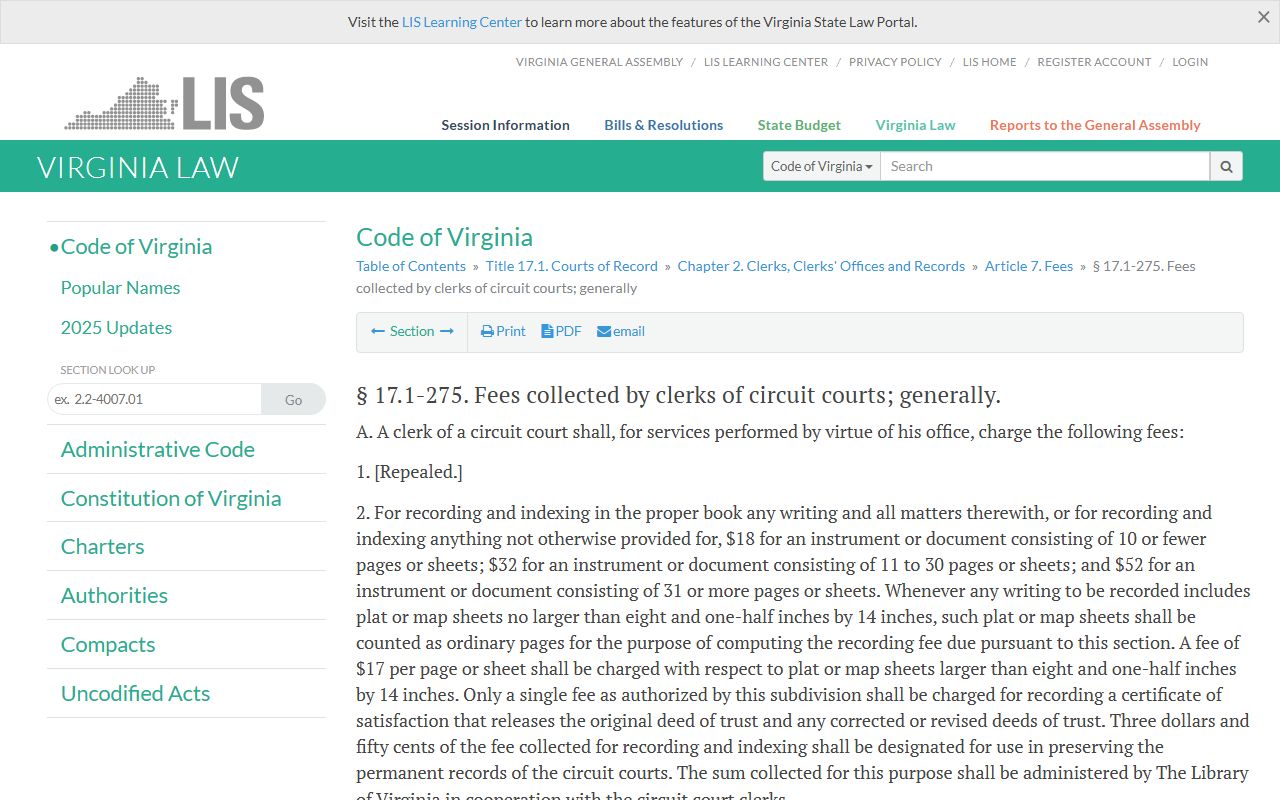
Fees for copies are set by § 17.1-275. The first certified copy of the decree is free. Each additional copy costs $0.50 per page plus $2.00 for certification. Plain copies cost $0.50 per page without the certification fee.
Virginia Code § 32.1-271 restricts access to VDH divorce certificates for 25 years from the date of the divorce. During that time, only the divorced parties or their immediate family with valid ID can get a certificate through VDH. Court records held by the clerk may be more accessible depending on whether any portion of the case was sealed.
If you are not sure whether the divorce was filed in Charlottesville or Albemarle County, check both. The Charlottesville/Albemarle Health Department at 1138 Rose Hill Drive (434-972-6200) may also be a resource for some local vital records questions, though divorce certificates go through VDH in Richmond.
Charlottesville Divorce Decree Fees
All Virginia circuit courts follow the same fee schedule set by state law. The filing fee for a divorce case in Charlottesville is $60 under § 17.1-275. This is the base fee and applies when you open the case.
Common fees you may encounter:
- Divorce filing fee: $60
- First certified copy of the decree: free
- Additional certified copies: $0.50 per page plus $2.00 certification
- Plain uncertified copies: $0.50 per page
- VDH divorce certificate: $12 per copy
If you need a divorce certificate -- a shorter document that confirms the divorce happened -- contact the Virginia Department of Health. VDH issues these for all Virginia divorces. The fee is $12 per certificate. Contact VDH at 804-662-6200 or go to vdh.virginia.gov/vital-records. Their office is at 8701 Park Central Drive, Suite 100, Richmond, VA 23227. Hours are Monday through Friday, 8:00 AM to 4:30 PM.
If you cannot afford the filing fee, the court may waive it. Ask the clerk's office about the fee waiver process when you contact them. Income-based waivers are available for people who qualify.
Filing for Divorce in Charlottesville
To file for divorce in Charlottesville, at least one spouse must have lived in Virginia for six months before filing under § 20-97. You file in Charlottesville Circuit Court if you are a city resident. If you live in Albemarle County, you file at Albemarle County Circuit Court. The address on your driver's license or voter registration is typically how the court determines where you live.
Virginia law allows both no-fault and fault-based divorce. No-fault requires a period of separation. If both spouses have a signed separation agreement and have no minor children, they can file after six months apart. Without an agreement, or when minor children are involved, the required separation period is one full year. Fault grounds exist for situations involving cruelty, adultery, desertion, or felony conviction with incarceration.
Steps to file for divorce in Charlottesville:
- Pick up or download the divorce petition (Bill of Complaint) from vacourts.gov or the clerk's office
- Complete the petition and file it with the clerk, paying the $60 fee
- Serve the other spouse with a copy or file a signed waiver
- Submit any separation agreement, property settlement, or parenting plan
- Attend a hearing or, for uncontested cases, submit affidavits and written evidence
Uncontested divorces often move through the Charlottesville court without a hearing. Both parties sign sworn statements, the clerk submits the package to a judge, and the judge signs the final decree if everything is in order. Contested cases take longer and may require hearings, mediation, or a trial. The clerk's office explains the process but cannot give legal advice.
Charlottesville and Albemarle County are separate jurisdictions with separate courts. Even though the county surrounds the city, city residents must file at Charlottesville Circuit Court. Confirm your residence is within city limits before you file.
What Charlottesville Divorce Records Contain
A divorce decree from Charlottesville Circuit Court is the final court order that legally ends the marriage. The clerk keeps the original decree along with the full case file. You may need the decree to enforce court orders, change your name, or update financial accounts after the divorce is final.
A standard Virginia divorce decree includes:
- Full names of both spouses
- Date and place of marriage
- Date separation began
- Grounds for the divorce
- Division of marital property and debts
- Spousal support terms if ordered by the court
- Child custody and visitation schedule (when children are involved)
- Child support amount and terms
- Date the judge signed the final decree
The case file held by the clerk also contains the original petition, proof of service, the separation agreement if one was filed, financial disclosures, and any motions or orders issued during the case. Parts of the file may be sealed at the court's direction. Parties to the case always have access to their own file. Others may have limited access depending on the nature of any sealed material.
The VDH divorce certificate is a much shorter document. It records the fact of the divorce without including property or custody details. That certificate is what you typically use to prove you are legally divorced for administrative purposes. The full court decree is needed to enforce specific terms like custody arrangements or property division.
Legal Help in Charlottesville
Charlottesville has access to legal aid services that can help with divorce and family law matters. If cost is a concern, start with the organizations below before paying for an attorney.
Virginia Legal Aid at valegalaid.org serves low-income Virginians statewide, including Charlottesville. They handle divorce, custody, and support cases for people who qualify based on income. Apply through their website or call to check if you meet the income guidelines. Services are free for eligible clients.
The Virginia State Bar at vsb.org offers a lawyer referral service. Search for family law attorneys in the Charlottesville area. Many offer a first consultation at a reduced flat rate. This is a good starting point if your case is contested or involves complex issues like business assets or custody disputes.
If you plan to file on your own, court forms for Virginia divorce cases are available at vacourts.gov. The site has petition forms, financial statements, custody forms, and other documents used in circuit courts across the state. The clerk's office can also tell you which forms apply to your situation, though they cannot advise you on how to handle your case legally.
The Charlottesville/Albemarle Health Department at 1138 Rose Hill Drive (434-972-6200) serves the area but is not a source for divorce records. For official divorce certificates, contact VDH in Richmond.
Nearby Virginia Cities
These independent Virginia cities are in the central Virginia region near Charlottesville. Each has its own Circuit Court for divorce filings.
Adjacent County
Albemarle County surrounds Charlottesville on all sides. County residents file at the Albemarle County Circuit Court, not at Charlottesville Circuit Court.