
Staunton Divorce Decree Records
Divorce decree records in Staunton are held by the Staunton Circuit Court Clerk. Staunton is an independent city in Virginia's Shenandoah Valley, which means it runs its own Circuit Court and does not share records with Augusta County. If you need to find a divorce case filed in Staunton, search for the decree, or get a certified copy, the Circuit Court Clerk is your first stop. The city has around 25,000 residents. Most divorce filings go through this court, and the Clerk keeps the official case files for all decrees entered here. You can request records in person or by mail. Some basic case details are also available online through the Virginia courts case information system.
Staunton Overview
Staunton Circuit Court Clerk
Staunton is an independent city. That means the Staunton Circuit Court stands on its own and is not part of Augusta County's court system. The Circuit Court Clerk keeps all divorce decree records filed here. This is where you go to get copies, look up old cases, or file new divorce papers. The Clerk's office is the starting point for any records request.
Staunton is part of Virginia's 25th Judicial Circuit, which also includes Waynesboro and Augusta County. The same group of judges hears cases across all three jurisdictions, but each city and the county keeps its own separate court records. If you're not sure where a divorce was filed, you may need to check both Staunton and Augusta County records.
| Office | Staunton Circuit Court Clerk |
|---|---|
| Address | Staunton, VA |
| Website | Virginia Courts - Circuit Courts |
| Hours | Monday through Friday, 8:30 AM to 4:30 PM |
When you visit the clerk's office, bring a valid photo ID. You'll need the full name of at least one spouse and, if you have it, the year the case was filed. Staff can look up cases by name and pull records from the file room. Certified copies cost more than plain copies, so know which type you need before you go.
How to Search Staunton Divorce Decree Records
You have two main ways to search for divorce records in Staunton: online through the state's case information system, or in person at the Circuit Court Clerk's office. Online searches give you basic information. In-person visits let you see the full case file and get certified copies.
The Virginia Judiciary's Case Information system at vacourts.gov lets you search by party name or case number. It shows party names, case type, filing date, and current status. It does not show the full text of the decree or any documents. It is free to use and does not require a login. This is a good place to start if you're trying to confirm a case exists or find a case number before contacting the clerk.
To search, you need at least one of these:
- Full name of at least one spouse
- The approximate year the divorce was filed
- A case number if you have one
If the online system doesn't show what you need, call or visit the Staunton Circuit Court Clerk directly. Staff can pull paper records, check archived files, and make copies. For older cases, records may be stored off-site, so calling ahead can save you a trip. Mail requests are also accepted. Include your name, contact info, the parties' names, the approximate year, and payment for any copy fees.
Keep in mind that divorce decrees in Virginia are sealed from the public for 25 years under Virginia Code § 32.1-271. Only the parties to the divorce and certain immediate family members can request access within that 25-year window. After 25 years, the records become available to the public. Bring your ID and be ready to explain your relationship to the case if you're not one of the parties.
Divorce Decree Fees in Staunton
Filing a divorce in Staunton costs $60 at the Circuit Court Clerk's office. That fee is set by state law under Virginia Code § 17.1-275. It covers the initial filing. There may be additional fees depending on what motions or orders are filed during the case.
When it comes to getting copies of a divorce decree, Virginia law provides that the first certified copy is free. This applies at the time the decree is entered. If you come back later to get a certified copy, fees apply. Under § 17.1-275, copies cost $0.50 per page plus a $2 certification fee for each certified document.
Other costs you may run into:
- Service of process fees if the other spouse must be formally served
- Commissioner in chancery fee if a referee is appointed in your case
- Publication costs if service by publication is needed
- Divorce certificate from VDH: $12 per copy
The Virginia Department of Health keeps its own divorce certificate records separate from the Circuit Court. VDH certificates are shorter documents that confirm a divorce happened. They cost $12 each. You can request them from the Virginia Department of Health Office of Vital Records at 8701 Park Central Drive Suite 100, Richmond VA 23227, or call (804) 662-6200. Office hours are Monday through Friday, 8 AM to 4:30 PM.
The Virginia Code section that governs these fees is publicly available. You can review the full text of § 17.1-275 on the state legislature's website to see exactly what each type of request costs.
The state legislature's website shows the current fee schedule for court clerks. Fees can change when the General Assembly updates the code, so check there if you need the most current numbers.
Filing for Divorce in Staunton
To file for divorce in Staunton, at least one spouse must have lived in Virginia for six months before filing. This residency rule comes from Virginia Code § 20-97. If you moved to Staunton recently and haven't hit the six-month mark yet, you'll need to wait before you can file here.
Virginia allows no-fault divorce. The most common path is a separation period. If you and your spouse have a written separation agreement and have no minor children, you need to live apart for six months before filing. If you have minor children or no written agreement, the separation period is one year. These are firm rules. Courts check this carefully before granting a decree.
Fault-based grounds are also available. Under Virginia law, you can cite adultery, cruelty, desertion, or a felony conviction as grounds for divorce. Fault cases often move faster than waiting out a separation period, but they are harder to prove. You'll need evidence and usually an attorney.
Once you file, the other spouse must be served with the divorce papers. If both spouses agree on all terms, you can file an agreed settlement. Uncontested cases where everything is settled can move through the Staunton Circuit Court relatively quickly. Contested cases take longer and may require hearings before a judge or a commissioner in chancery.
Virginia Code sets the grounds and procedures for divorce statewide. The Staunton Circuit Court follows the same rules as every other Virginia Circuit Court. You can review the grounds for divorce at Virginia Code § 20-91 on the state legislature's site.
The Virginia Courts website shows the current text of § 20-91, which lists all recognized grounds for divorce in the state. The site also has links to the full Virginia Code if you need to look up related sections.
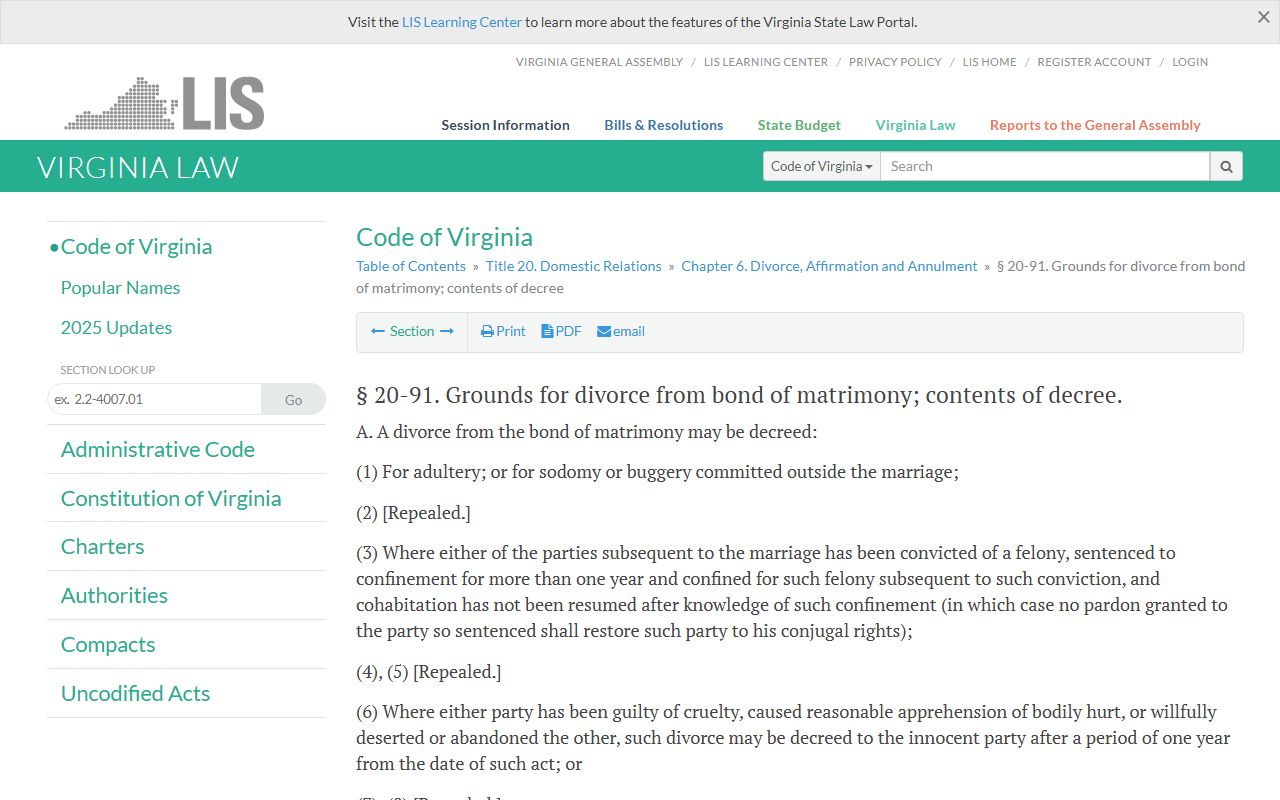
The page at law.lis.virginia.gov displays the full statutory text for § 20-91, including all recognized fault and no-fault grounds for divorce in Virginia.
What a Staunton Divorce Decree Contains
A Virginia divorce decree is the final court order that ends a marriage. It is signed by a Circuit Court judge and entered into the court's official record. The decree says the marriage is dissolved and lays out the terms the court ordered or the parties agreed to.
Most divorce decrees in Staunton will include:
- Full legal names of both spouses
- Date and place of the marriage
- Grounds for divorce cited in the case
- Date the decree was entered by the court
- Property division terms if addressed in the order
- Spousal support terms if applicable
- Child custody and visitation if minor children were involved
- Child support order if applicable
- Name restoration if one spouse requested it
The decree itself is the primary document you need to prove a divorce happened. Courts, government agencies, and many institutions will ask for a certified copy. A plain copy is usually fine for personal reference, but for legal purposes you'll need the certified version with the clerk's seal and signature.
Some decrees incorporate a separate property settlement agreement by reference. If that's the case, you may need to request that document separately. Ask the clerk if the agreement is part of the file when you make your request.
Legal Help for Divorce in Staunton
Several resources can help Staunton residents deal with divorce cases. Some offer free or low-cost help for people who qualify. Others can point you to an attorney in the area.
Virginia Legal Aid covers the Shenandoah Valley region and offers free civil legal help to people who meet income guidelines. Family law cases, including divorce, are part of what they handle. You can find out more at valegalaid.org or call their statewide referral line to find the office closest to Staunton.
The Virginia State Bar runs a lawyer referral service that can connect you with an attorney who handles divorce cases in the Staunton area. Visit vsb.org for more information. Many family law attorneys offer an initial consultation, so you can get a sense of your situation before committing to representation.
The Virginia Courts website also has self-help resources for people filing without an attorney. Forms and instructions are available online. If your case is uncontested and straightforward, it may be possible to handle it without a lawyer. But if there are disputes over property, custody, or support, getting legal advice is worth the cost.
Augusta County Divorce Records
Staunton is an independent city surrounded by Augusta County. Even though they share the same judicial circuit, each keeps separate records. If you aren't sure whether a divorce was filed in the city or the county, you may need to check both. Visit the Augusta County page for information on the county's Circuit Court and how to search records there.
Nearby Cities
These nearby Virginia cities each have their own Circuit Court and handle divorce decrees independently.